



THE MEANING AND ORIGIN OF THE BUDDHIST FLAG
The Meaning and Origin of the Buddhist Flag
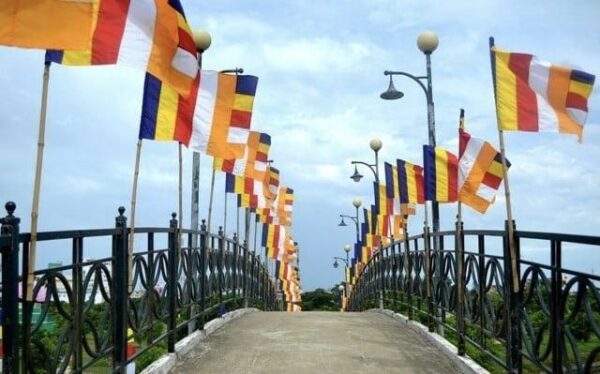
Every follower of the Buddha should always respect and protect the Buddhist flag because it symbolizes Buddhism, unity, and non-discrimination among Buddhists around the world.
What does the Buddhist flag represent? Why does it have five different colors, and what is the meaning of each color?
⸻
The Origin of the Buddhist Flag
According to Hoa Sen Library, the Buddhist flag was designed by Colonel Henry Steel Olcott, who was born on August 2, 1832, in New Jersey, USA, and passed away on February 17, 1907, in Adyar, India. He previously served as a Colonel in the United States Navy.
Henry Steel Olcott made remarkable contributions to the revival of Buddhism in Sri Lanka. Inspired by the renowned Sri Lankan Buddhist reformer Anagarika Dharmapala, a disciple of Olcott, Buddhism was restored in India on January 21, 1891, and from there gradually spread throughout the Western world.
After taking refuge in the Triple Gem, Henry Steel Olcott established Buddhist schools across Sri Lanka, from cities to rural villages. He also advocated for the establishment of Buddhist educational institutions in countries such as Japan, Thailand, Myanmar, and India.
In 1889, Olcott and the Venerable Sumangala Thera of Sri Lanka created a Buddhist flag based on the six-colored aura of the Buddha: dark blue, yellow, red, white, orange, and the combined color formed from all five.
The flag design was first published in the newspaper Sarasavi Sandaresa on April 17, 1885, and was first flown during Vesak (Buddha Day) on April 28, 1885. This marked the first Vesak celebration in Sri Lanka under British colonial rule.
Later, Colonel Henry Steel Olcott modified the flag into its present rectangular design for easier use. The revised flag was first displayed during the 1886 Vesak celebration.
On May 25, 1950, the World Fellowship of Buddhists officially adopted it as the international Buddhist flag.
In Vietnam, on May 6, 1951, during the Three-Region Buddhist Congress held at Tu Dam Pagoda in Hue, Venerable To Lien (former abbot of Quan Su Pagoda in Hanoi) presented the World Buddhist Flag to the congress. The assembly officially adopted it as the Buddhist flag of Vietnam.
Today, the Buddhist flag is flown at temples and monasteries throughout the world.
⸻
The Five Colors of the Buddhist Flag
The Buddhist flag primarily symbolizes the unity of Buddhists around the world.
It also represents unwavering faith, peace, and the aspiration to transcend attachment to regional or national boundaries, fostering solidarity in the service of the Dharma and humanity.
The five vertical stripes are:
* Dark Blue
* Yellow
* Red
* White
* Orange
The sixth stripe consists of the combination of all five colors, symbolizing the radiance of the Buddha.
⸻
Meaning of Each Color
Dark Blue
Represents Concentration (Samādhi), symbolizing vastness, serenity, and clarity of mind.
Yellow
Represents Mindfulness, because through mindfulness one develops concentration, which in turn gives rise to wisdom.
Red
Represents Diligence (Right Effort). Through persistent effort, one overcomes obstacles and adversity.
White
Represents Faith, an unwavering confidence in the Buddha and the Dharma. Faith serves as the foundation for cultivating all wholesome qualities.
Orange
Represents Wisdom (Prajñā). When faith, diligence, mindfulness, and concentration are fully developed, wisdom naturally arises.
The Combined Color
Represents the unity and harmony of Buddhists throughout the world.
⸻
Overall Symbolism
Thus, the five colors symbolize the Five Spiritual Faculties (Pañca Indriya) and the Five Spiritual Powers (Pañca Bala) in Buddhism.
The Buddhist flag also embodies the spirit of harmony, compassion, equality, and peaceful coexistence.
Buddhism advocates peace. Although humanity consists of many races and cultures, Buddhists regard one another as members of one universal family.
Guided by compassion, equality, and the principle of harmonious living, Buddhism rejects discrimination based on class, ethnicity, or race. All beings possess the same inherent potential for enlightenment, known as Buddha-nature.
Therefore, beyond representing Buddhist teachings, the Buddhist flag also expresses the ideals of unity, harmony, and mutual respect among all people.
To understand deeply about Mekong Delta culture you should you book a Mekong Delta tour with local travel acengy.
The Mekong Delta Tours pack everything for your needs and help tourists with a guide and all transport was pre-arranged, also boats, cars, bikes, ferries. You can save a lot of time travelling to go straightforward and would perhaps offer much of an experience to make the best use of your time.
Or you can check in TRIPADVISOR of MEKONGECOTRAVEL to know how tourists did a satisfied tour with us:
https://www.tripadvisor.com/Attraction_Review-g303942-d26314076-Reviews-MekongEcoTravel-Can_Tho_Mekong_Delta.html
